MediaLab at the Athens Science Festival

Logo of Athens Science Festival
MediaLab participated in the Athens Science Festival event as part of the Athena Research Centre’s science and technology exhibition at the Technopolis-Athens. Great week for young people and the general public to peek at the weird and wonderful world of science and technology!

MediaLab’s exhibition theme was “3D scanning, viewing and printing” and was briefly described as follows:

Digitization (or scanning) of objects in three dimensions is now a widespread practice that enables the complete optical documentation of the objects of our world.
With the real-world objects being brought to a 3D virtual world, we have the possibility of inspecting them interactively from any desired viewpoint, gaining significantly more insight than by a typically viewing a photo that provides just a single static viewpoint.
In the specific case of the digital documentation of cultural heritage, 3D digitization has been successfully used in capturing the geometry and colour of objects or monuments with multiple objectives, such as recording the current state (visual documentation), providing means for enhanced study-investigation, supporting conservation-restoration activities, empowering education and culture dissemination, even supporting physical reproduction using 3D printing.
The cultural technology team at the MediaLab of “Athena RIC” has developed extensive know-how in cultural technologies and specifically 3D digitization and VR applications in cultural heritage and presents here contemporary approaches for 3D digitization of cultural objects, along with easy-to-use techniques for Web dissemination and simple 3D printing capabilities.

MediaLab’s participation included the demonstration of

  • two 3D scanning techniques (based on structure from motion and structured light)
  • 3D viewing of 3D scanned content in 3D TVs without glasses
  • 3D printing of 3D scanned or modelled content on a simple 3D PLA-based printer
  • a virtual museum framework for educational practice based on gaming technologies
  • a game-based learning integrated educational system based on gaming technologies, along with Doukas Schools, Omega Technology and Byte Computer

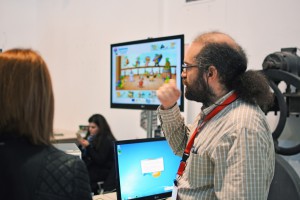
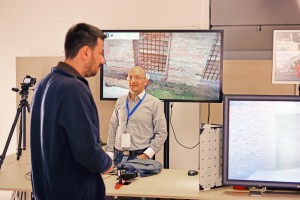
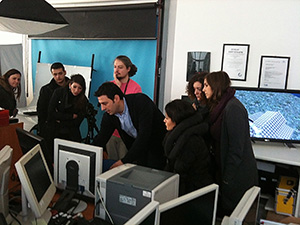
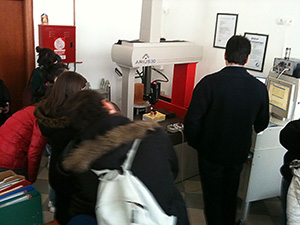
Here is a gallery of photos of MediaLab’s exhibition at the event:

3D digital cultural heritage A to Z

3D digital cultural heritage begins its life with 3D digitisation as part of a complete 3D recording approach and completes with the 3D applications and reproduction. 3D physical reproduction has gained momentum in the recent years as 3D printing technologies are becoming more and more accessible, mainly due to the reduction of cost both in hardware and in consumables used for printing.
Recently our lab acquired one such 3D printing system, the CubeX by 3D Systems. With this system our lab has now completed the puzzle of 3D digital cultural heritage, covering all aspects involved. With an Arius 3D laser scanning system, a customised structured light scanner based on the David 3D scanning system, a shape from silhouette scanning system and a Structure-From-Motion-Dense Multi-View 3D Reconstruction method with a turntable, along with an Optech Ilris 3D time-of-flight laser scanning system for large structures and open spaces, we are able to cover a diversity of 3D digitisation projects. With a long experience in data structures, cultural documentation and work for Europeana we are able to support any cultural documentation project. Our even longer experience in multimedia applications for cultural heritage in many forms and platforms covers numerous possibilities for digital delivery, scientific study, education and entertainment. Now with the addition of the CubeX 3D printing system we are able to cover the aspect of physical reproduction.

Our newly acquired CubeX system characteristics in brief:
Z axis resolution:
0.100mm (0.004” / 100 microns)
X-Y resolution:
+/- 1% of object dimension or +/- 0.2mm (0.008” / 200 microns) whichever is greater
Maximum build size:
275mm (w) x 265mm (l) x 240mm (h) or 10.75” x 10.75” x 9.5”

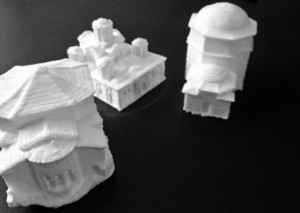
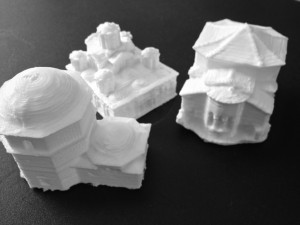
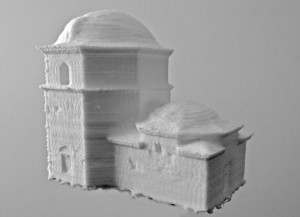
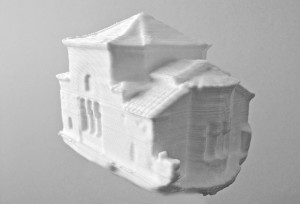
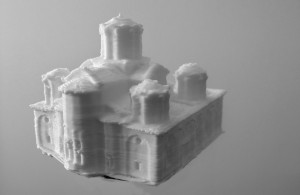
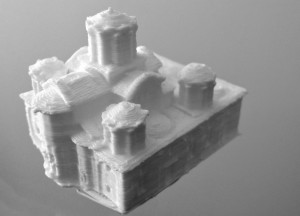
Here are a few draft 3D printed models from our previous work on monument digitisation:
IMG_01384 IMG_01385
IMG_01376IMG_01374
IMG_01379IMG_01382

Invited talks at AUTH seminar

Anestis Koutsoudis and George Pavlidis participated in the Seminar “Diagnostic techniques in the science of artworks curation” organized by the Crossdisciplinary Postgraduade Programme “Protection, Conservation and Restoration of Cultural Monuments” of the Aristotle University of Thessaloniki, held 17th-19th Feb. 2012.

This included invited talks at Aristotle University of Thessaloniki and a visit at the Multimedia Department of the Athena Research Center in Xanthi.

Here is the seminar program (greek).
Here is a simplified PDF version Dr. Koutsoudis’ talk (greek) and a simplified PDF version of Dr. Pavlidis’ talk (english).

Here are a couple of photos from the 3D technologies demonstration @ the Multimedia Department.

Testing WebGL technology…

This is a demo of five 3D digital replicas of artefacts that one can examine in a WebGL enabled browser.

It uses the X3DOM script to exploit the WebGL functionality in order to visualise real time 3D graphics without the need of any additional plug-ins in a Web page.

By adviced that not all web browsers are compliant with the WebGL standard yet.

Content-based Virtual Museum navigation

Content based retrieval engine in a Virtual Museum of Pottery
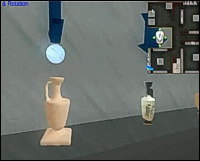
An interactive virtual museum of 3D pottery artefacts has been used as a case study. The virtual visitor can perform queries to the system like ‘Where in this 3D scene I can find vessels similar to this’. Again an attempt to combine a content-based retrieval mechanism within an interactive real time 3D enviroment.

3D digitization of Urban Areas

The project involved the three-dimensional digitization and reconstruction of urban areas. The project deals with the idea of combining the usage of commercial and open source software systems in 3D graphics in order to produce realistic virtual walkthroughs for culture heritage promotion with a minimum budget and low cost infrastructure.

We have attempted the 3D reconstruction of three urban areas from three different cities without the use of any expensive equipment (e.g. commercial 3D range scanners based on techniques like triangulation, modulation or time-of-flight).

We have produced a fully textured 3D model that can be easily accessed from the Internet using a VRML viewer plugin for the browser. Acceptable downloading times have been achieved even for slow connections by reducing the texture map quality.
Access to the three-dimensional reconstructions requires the installation of a VRML viewer.

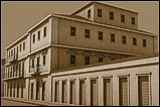
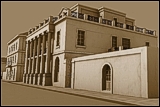
3D reconstruction of Argostoli

A virtual walkthrough at the port of Argostoli, Kefalonia, as it was before the devastating earthquake of 1953.

The three-dimensional reconstruction of the area, based on topographic maps, historical photographs and documentary material, depicts the area of the port of Argostoli at the time before the earthquake.

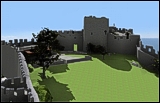
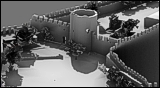
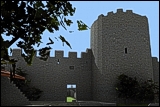
3D digitization of the Byzantine fortress of Kavala

The Byzantine fortress of Kavala is located on top of the peninsula of Virgin Mary, where the old town is built. In Byzantine times and later, many successive reconstructions and alterations to the fortifications have been made by the Byzantines, the Venetians and the Turks.

The fortress at its present condition was built during the first quarter of the 15th century and is based on the foundations built during the Byzantine period.

The 3D digitization of the fortress was done by using time-of-flight scanning technology. For the reconstruction and virtual representation, photorealistic shading technologies have been employed in order to present the fortress with lighting similar to that of a sunny summer day.

3D Digitization of Monuments

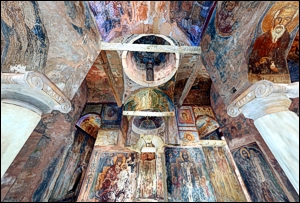
Case: Digitization of Religious Monuments in the region of Mani, Peloponnese

The project involves the digitization and 3D reconstruction of a Byzantine church in the area of Stavri in Mani and the Post-Byzantine church of Aghios Vasileios in the Kelefa settlement. The goal of the project was the universal dissemination of the monuments. The virtual walkthrough includes the exterior as well as the interior of the churches.

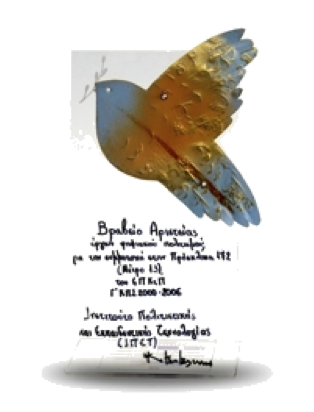
Award of Excellence

The Excellence Award for projects in digital culture was awarded to the Institute for its successful participation in Calls 65 and 172 of the Operational Programme “Information Society” of the Third Framework Programmes 2000-2006, and specifically for the project “DIGITECH-III: Study of three-dimensional digitisation technologies” coordinated by Dr. George Pavlidis, Principal Researcher of the Institute.

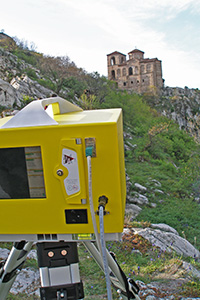
3D Digitization of a monument

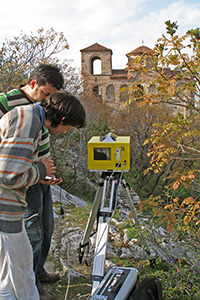
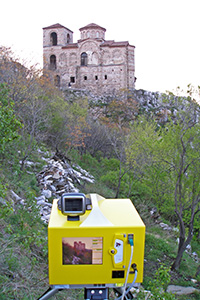
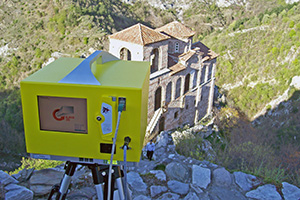
Under the scope of INTERREG ΙΙΙ A / PHARE CBC – “Cooperation network for knowledge dissemination on 3D digitiza-tion applications” project, staff of the Department traveled to South Bulgaria accompanied by the Bulgarian partners in order to exchange information on 3D digitization of large scale monuments and to proceed to a case-study digitization of a monuments that dates back to the Byzantine era.
Time-of-flight was used as the principal method for the 3D digitization by using an Optech ILRIS3D scanning device.
The travel was a big success, the Bulgarian partners were very hospitable, the little village named ‘Kosovo’ in the mountainous area absolutely picturesque and the monument great for our case-study.

Third International Conference of Museology

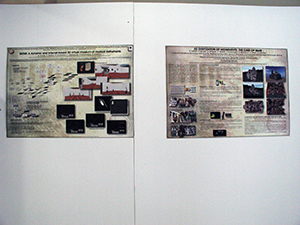
A very successful participation of the Department in the Third International Conference of Museology held at Mytilene, Greece, on 5-9 June, 2006. Two papers and two posters accepted for publication.

  • G. Pavlidis, D. Tsiafakis, F. Arnaoutoglou, K. Balla, A. Pikrakis, C. Chamzas, “Musical Universe”
  • G. Pavlidis, D. Tsiafakis, A. Koutsoudis, F. Arnaoutoglou, V. Tsioukas, C. Chamzas, “Recording Cultural Heritage”
  • G. Pavlidis, D. Tsiafakis, G. Provopoulos, S. Chatzopoulos, F. Arnaoutoglou, C. Chamzas, “MOMI: A dynamic and internet-based 3D virtual museum of musical instruments”
  • G. Pavlidis, N. Tsirliganis, D. Tsiafakis, F. Arnaoutoglou, C. Chamzas, “3D digitization of monuments: the case of Mani”