Call for collaboration under the Greek National Project ‘GameIt’

logo-GameIT
The Multimedia Research Group has an open call for 4 external collaborators for the purposes of the Greek National Project ‘GameIt‘. The call is open till June 19, 2014, 15:00. A brief description of the vacancies is as follows:

  1. Two (2) electrical or informatics engineers for the development of
    • Ontology mapping system
    • Serious games scenario editor (world & scenario editor)
    • Multiplayer online game system
  2. Two (2) historians/archaeologists or/and art historians for
    • Collection and cataloguing of cultural and educational sources
    • Analysis and rating of cultural and educational resources
    • Mapping of ontologies of various resources to the ontology of ‘GameIt’
    • Collection, cataloguing and analysis of thesauri and vocabularies

Extensive call description can be found at the ILSP job vacancies page.

—————————————— Greek version

Η Ομάδα Έρευνας Πολυμέσων αναζητά 4 συνεργάτες για τις ανάγκες του Εθνικού έργου ΠΑΒΕΤ ‘GameIt‘. Η πρόσκληση είναι ανοικτή έως τη 19η Ιουνίου 2014, ώρα 15:00. Μια συνοπτική περιγραφή των εν λόγω θέσεων ακολουθεί:

  1. Δύο (2) μηχανικοί/πληροφορικοί για την ανάπτυξη
    • Συστήματος αντιστοίχισης οντολογιών
    • Μηχανή συγγραφής σεναρίων παιχνιδιών (world & scenario editor)
    • Σύστημα πολυσυμμετοχκού διαδικτυακού παιχνιδιού
  2. Δύο (2) ιστορικοί/αρχαιολόγοι ή/και ιστορικοί τέχνης για
    • Συλλογή και καταγραφή πολιτιστικών και εκπαιδευτικών πηγών
    • Ανάλυση και διαβάθμιση πολιτιστικών και εκπαιδευτικών πηγών
    • Αντιστοίχιση οντολογιών πηγών με την οντολογία του έργου ‘GameIt’
    • Συλλογή, καταγραφή και ανάλυση θησαυρών όρων και λεξικών

Αναλυτική περιγραφή της πρόσκλησης βρίσκεται στη σελίδα ανοικτών θέσεων συνεργασίας του ΙΕΛ.
3D digital cultural heritage A to Z

3D digital cultural heritage begins its life with 3D digitisation as part of a complete 3D recording approach and completes with the 3D applications and reproduction. 3D physical reproduction has gained momentum in the recent years as 3D printing technologies are becoming more and more accessible, mainly due to the reduction of cost both in hardware and in consumables used for printing.
Recently our lab acquired one such 3D printing system, the CubeX by 3D Systems. With this system our lab has now completed the puzzle of 3D digital cultural heritage, covering all aspects involved. With an Arius 3D laser scanning system, a customised structured light scanner based on the David 3D scanning system, a shape from silhouette scanning system and a Structure-From-Motion-Dense Multi-View 3D Reconstruction method with a turntable, along with an Optech Ilris 3D time-of-flight laser scanning system for large structures and open spaces, we are able to cover a diversity of 3D digitisation projects. With a long experience in data structures, cultural documentation and work for Europeana we are able to support any cultural documentation project. Our even longer experience in multimedia applications for cultural heritage in many forms and platforms covers numerous possibilities for digital delivery, scientific study, education and entertainment. Now with the addition of the CubeX 3D printing system we are able to cover the aspect of physical reproduction.

Our newly acquired CubeX system characteristics in brief:
Z axis resolution:
0.100mm (0.004” / 100 microns)
X-Y resolution:
+/- 1% of object dimension or +/- 0.2mm (0.008” / 200 microns) whichever is greater
Maximum build size:
275mm (w) x 265mm (l) x 240mm (h) or 10.75” x 10.75” x 9.5”

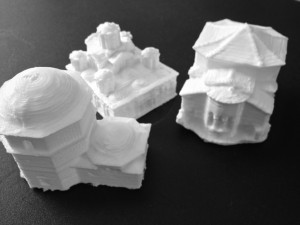
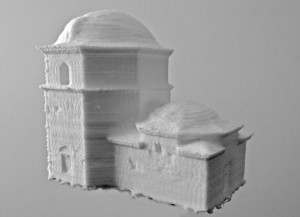
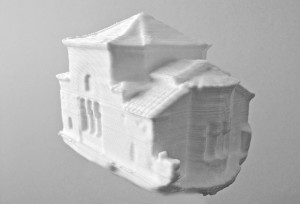
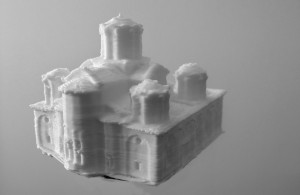
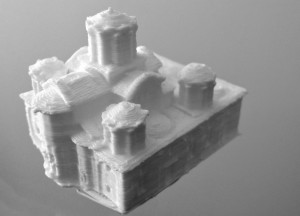
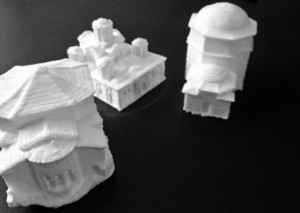
Here are a few draft 3D printed models from our previous work on monument digitisation:
IMG_01384 IMG_01385
IMG_01376IMG_01374
IMG_01379IMG_01382

Content-based Virtual Museum navigation

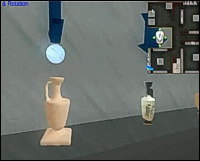
Content based retrieval engine in a Virtual Museum of Pottery
An interactive virtual museum of 3D pottery artefacts has been used as a case study. The virtual visitor can perform queries to the system like ‘Where in this 3D scene I can find vessels similar to this’. Again an attempt to combine a content-based retrieval mechanism within an interactive real time 3D enviroment.

3D digitization of Urban Areas

The project involved the three-dimensional digitization and reconstruction of urban areas. The project deals with the idea of combining the usage of commercial and open source software systems in 3D graphics in order to produce realistic virtual walkthroughs for culture heritage promotion with a minimum budget and low cost infrastructure.

We have attempted the 3D reconstruction of three urban areas from three different cities without the use of any expensive equipment (e.g. commercial 3D range scanners based on techniques like triangulation, modulation or time-of-flight).

We have produced a fully textured 3D model that can be easily accessed from the Internet using a VRML viewer plugin for the browser. Acceptable downloading times have been achieved even for slow connections by reducing the texture map quality.
Access to the three-dimensional reconstructions requires the installation of a VRML viewer.

3D reconstruction of Argostoli

A virtual walkthrough at the port of Argostoli, Kefalonia, as it was before the devastating earthquake of 1953.

The three-dimensional reconstruction of the area, based on topographic maps, historical photographs and documentary material, depicts the area of the port of Argostoli at the time before the earthquake.

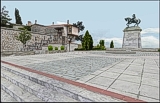
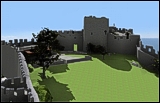
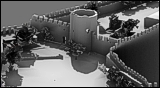
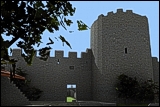
3D digitization of the Byzantine fortress of Kavala

The Byzantine fortress of Kavala is located on top of the peninsula of Virgin Mary, where the old town is built. In Byzantine times and later, many successive reconstructions and alterations to the fortifications have been made by the Byzantines, the Venetians and the Turks.

The fortress at its present condition was built during the first quarter of the 15th century and is based on the foundations built during the Byzantine period.

The 3D digitization of the fortress was done by using time-of-flight scanning technology. For the reconstruction and virtual representation, photorealistic shading technologies have been employed in order to present the fortress with lighting similar to that of a sunny summer day.

3D Digitization of Monuments

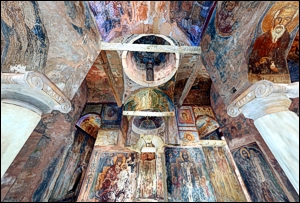
Case: Digitization of Religious Monuments in the region of Mani, Peloponnese

The project involves the digitization and 3D reconstruction of a Byzantine church in the area of Stavri in Mani and the Post-Byzantine church of Aghios Vasileios in the Kelefa settlement. The goal of the project was the universal dissemination of the monuments. The virtual walkthrough includes the exterior as well as the interior of the churches.

ISO 9001:2008

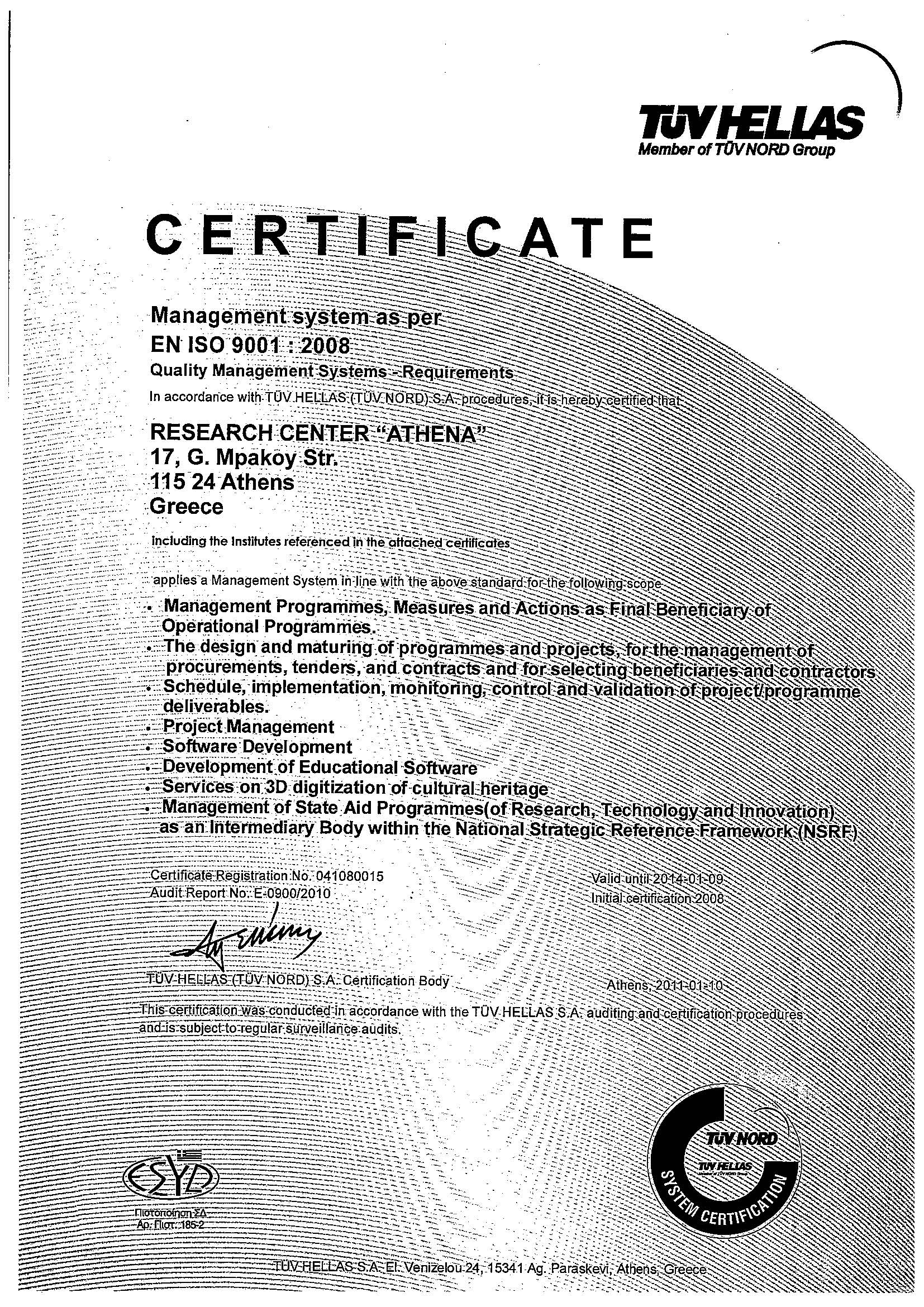
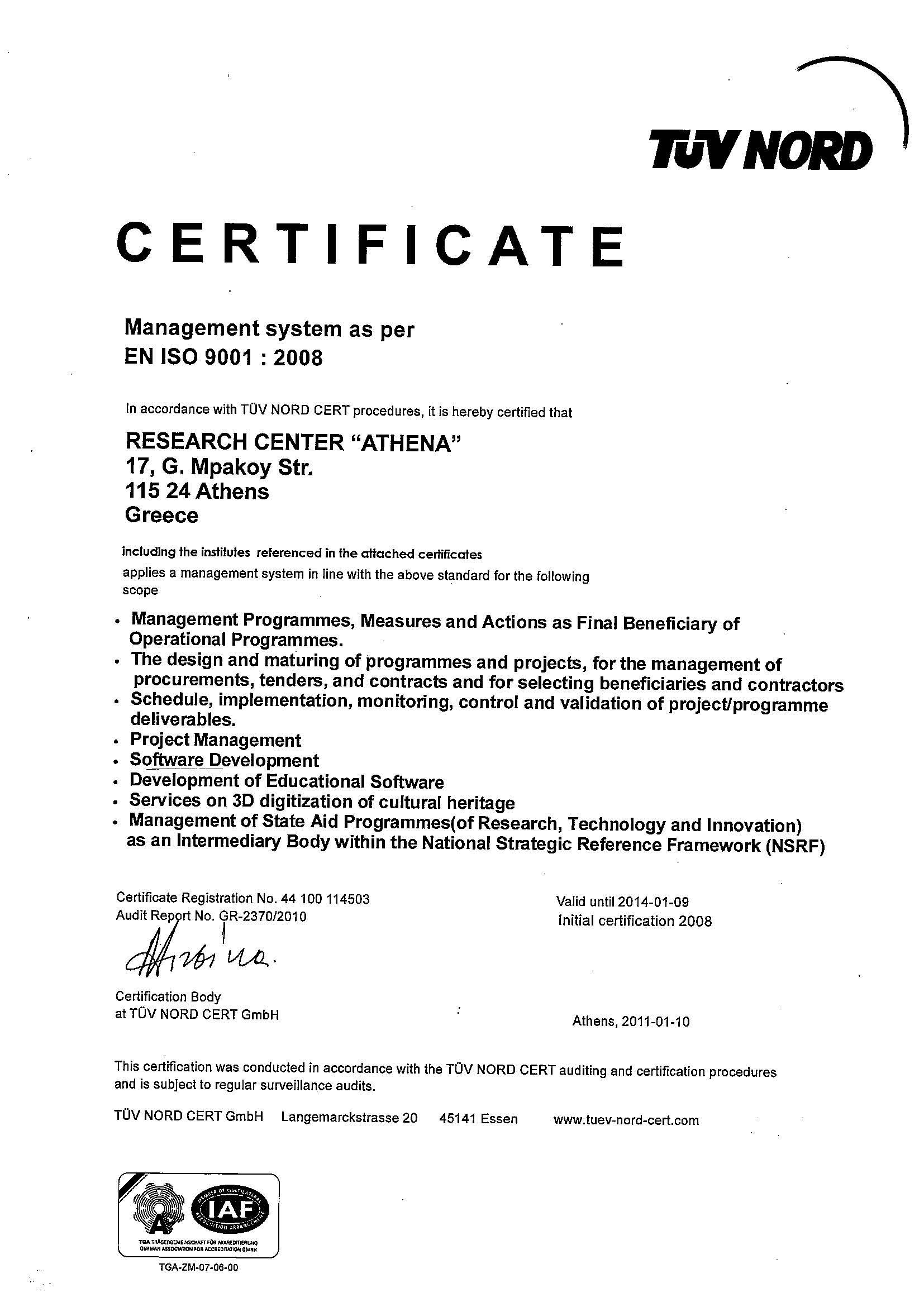
The Multimedia Department has successfully renewed its ISO 9001:2000 into ISO 9001:2008 certificate for its services on 3D digitization of cultural heritage.

ISO_9001_2000_20110110_TUV_HELLASISO_9001_2000_20110110_TUV_NORD

ISO 9001:2000

The Multimedia Department has successfully acquired an ISO 9001:2000 certificate for its services on 3D digitization of cultural heritage.

ISO_9001_2000_20080118_1ISO_9001_2000_20080118_2